From office move to operating model: what happens after go-live?  

For legal, financial and professional services firms, a major office move has become much more than a change of address.

  • Client Experience
  • The Office
  • Workplace Transformation
From office move to operating model: what happens after go-live?  

The new workplace must support changing patterns of work, increasingly sophisticated client expectations, technology, sustainability commitments and the experience organisations want to create for their people. It is a significant operational and financial commitment, designed, planned and imagined years before anyone walks through the door.  

That creates an uncomfortable question for leaders responsible for workplace transformation:  

How do you design today for a workplace whose future patterns of use you cannot confidently predict?  

It is tempting to answer that question through the building itself: more flexible space, new technology, different ratios of desks to collaborative space, more sophisticated client areas and better amenities.  

All of those things are essential, but ultimately their value depends on something less visible: how seamlessly and friction-free the workplace operates once people begin using it.

In our experience of supporting clients through complex, high-profile office moves, go-live is not the point at which uncertainty disappears. It is when uncertainty becomes visible. 
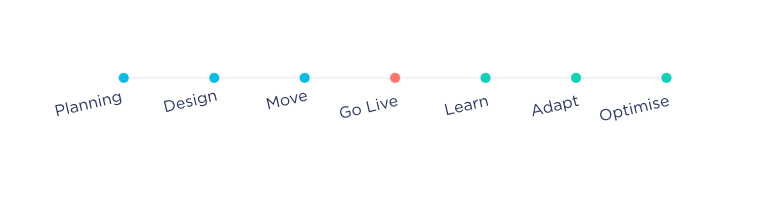
A timeline reading Planning → Design → Move → GO-LIVE → Learn → Adapt → Optimise

Decisions today, occupation years later  

Major moves across legal and professional services bring this challenge into focus, with some prominent firms planning new workplaces five years before occupation.  

Simmons & Simmons announced in March 2025 that it would relocate its London office to 25 Finsbury Circus in 2030. The firm's plans include flexible office layouts, wellbeing facilities, amenities and significant sustainability ambitions.  

In February 2026, Herbert Smith Freehills Kramer announced an agreement for a new London office at 8 Exchange Square, with occupation also expected in 2030. It described the future environment as being designed around the needs of its people and clients, with modern workspace, dedicated reception and ambitious sustainability objectives.  

Both examples illustrate the length of the planning horizon, with workplace plans being shaped several years before occupation. Yet the expectations of how employees and clients will interact with that workplace will continue evolving throughout the intervening period.  

Trying to predict every requirement is therefore unlikely to be enough. A better question might be: how can adaptability be designed into the way the workplace will operate? 

Protecting the value of the investment 

Knight Frank's 2025 research found that financial and professional services were driving London office demand, while legal and financial occupiers led overall capital expenditure per project because of their high design specifications and performance expectations. Two-thirds of new London leasing activity was focused on premium or comprehensively refurbished office space, compared with around 45% before the pandemic.  

The cost of creating these environments is substantial. Published UK benchmarks place a typical office fit-out at between £58 to £120 per square foot, depending on specification and scope. For a major London office, that will represent a multi-million-pound commitment. Add the time, capital and management attention involved, and the cost of getting the operating experience wrong after move-in becomes significant. 

When the plan meets human behaviour 

Before occupation, workplace decisions inevitably rely on data, insights, research and assumptions. There will be detailed forecasts around occupancy, meeting rooms, visitor flows, technology, service demand and employee behaviour. Intricate processes will be designed. Systems will be configured. Teams will be trained.  

Then people arrive.  This is the moment when planned behaviour meets actual behaviour, and often this is where the friction appears. 

Clients may use spaces differently than expected. Employees may continue using familiar processes rather than adopting new ones. New technology may not integrate with established workflows as expected. Demand may peak in different places. Seemingly small questions or unintended workarounds may begin appearing repeatedly, creating a disproportionate operational impact. None of this necessarily means that the workplace has been designed badly. It means that occupation reveals frictions and frustrations that planning alone cannot fully predict. 

Before go-live, organisations design around forecasts, requirements and evidence-based assumptions. After go-live, they can improve using real operational data.  

The opportunity is to make that second stage a deliberate part of the transformation.  The experience at City law firm Travers Smith offers a practical example. Ahead of its move to Stonecutter Street, ComXo worked onsite to understand the firm's room-booking environment, processes and systems, building the operational knowledge needed before the new office went live. This helped protect continuity through the transition and created an opportunity to evolve and tailor familiar processes for the new workplace.  

After go-live, flexible overflow and out-of-hours support gave the front-of-house team additional resilience as demand changed, while ongoing service observations highlighted further opportunities for improvement.  

The learning extends beyond room booking: an office move is an opportunity to understand existing friction, remove unnecessary complexity and build resilience before it reaches the new workplace.  

Friction isn't always failure  

One complication is knowing which feedback signals require action, particularly during the pace and pressure of the go-live phase.  A new workplace asks people to adjust in several ways. New surroundings, systems, services and working practices inevitably create a period of acclimatisation.  

The challenge is knowing how and when to respond. Respond to every complaint immediately and there is a risk of reshaping the new environment around legacy behaviours that the move was intended to change. Ignore emerging problems for too long and genuine operational friction can become embedded, creating lasting service or experience issues.  

Travers Smith managed this phase through a structured change-request process. Following the move, requests were documented and reviewed rather than triggering an immediate response. This helped the firm avoid reacting too quickly to requests that might reflect legacy behaviours, while giving people time to acclimatise to the new working environment.  

The principle extends beyond any single process. Organisations need to distinguish between the temporary friction of change and evidence that something genuinely isn't working. That requires governance and operational insight, rather than gut feel alone.  

The workplace is already telling you where the friction is  

Everyday workplace interactions make operational friction visible.  A request for help is a service interaction. So is a room-booking query, a repeated question, a failed handover or an escalation. 

Individually, each may appear relatively insignificant. Collectively, they can begin telling an organisation something about how effectively its workplace is functioning.  

  • Are the same questions repeatedly being asked?  
  • Are employees bypassing self-service?  
  • Are particular processes difficult to navigate?  
  • Where does demand regularly exceed available capacity?  
  • Which issues disappear as people acclimatise, and which persist?  

At Travers Smith, the activity handled following go-live provided more than service continuity. It also highlighted opportunities across knowledge, self-service, process, technology and reporting, creating a clearer picture of where actual workplace behaviour differed from the planned experience.  

The significance goes beyond room booking. Interactions are not simply transactions to be processed. They can provide evidence of where the lived workplace experience differs from the one that was designed.  That is potentially one of the most valuable sources of post-occupation intelligence available to workplace leaders.  

Client and employee experience determines whether the workplace delivers  

This becomes more important as organisations encourage people to spend more time together in the office.  Research from JLL suggests that employees broadly recognise the value of being together in the office, but their response to more structured attendance is closely connected to the wider workplace experience. For organisations investing heavily in new offices, the challenge is therefore not simply to get people through the door, but to ensure the experience works once they arrive.  

The new office may be beautifully designed, technically advanced and environmentally efficient. But employees and clients experience it through everyday journeys: finding the right space, accessing support, arranging meetings, welcoming visitors, resolving problems and navigating the organisation. That places the operating experience alongside the physical workplace as part of the overall return on the investment.

Build for uncertainty rather than trying to eliminate it  

There is no realistic way for an organisation planning a move today to know precisely what will be required several years from now.  Perhaps that shouldn't be the objective.  
Future-proofing a workplace isn't about correctly predicting every future requirement. It is about creating enough operational flexibility to respond when those requirements change.  

That means balancing resilience with efficiency, building knowledge before it is urgently needed, understanding where capacity can flex and creating clear routes for navigation and escalation. Critically, it also means establishing ways to listen to what workplace interactions reveal after occupation.  An operating model capable of adapting and scaling alongside the organisation changes how the success of an office move should be measured.  

The question at go-live is understandably:  Did we deliver what we planned? Have we created an operating experience capable of adapting to what happens next? 

The more valuable question over the months and years that follow may be:  Have we created an operating experience capable of adapting to what happens next?  

The move is a milestone. The workplace keeps moving.  A new office represents years of planning and millions of pounds of investment. Yet opening the doors cannot be the end of the workplace transformation programme. It is the point at which many of the assumptions behind that investment finally encounter operational reality.  

For COOs, Transformation and Client Experience Leads, the opportunity is therefore to widen the scope of office-move planning. Alongside property, design and technology, leaders need to consider how the workplace will operate, how service and experience will be protected as demand changes, and how the organisation will recognise when something isn't working as intended.  This is where ComXo sees an important shift in workplace thinking.  

The physical workplace provides the environment, but the operating model determines how effectively people navigate and experience it, while the interactions taking place every day provide the intelligence needed to keep improving it.  

For organisations making long-term workplace decisions in a world that will continue to change, adaptability may ultimately prove more valuable than trying to get every assumption right on day one. 

Written by
Amanda

Business continuity isn’t just for cyberattacks.  

  • Uncategorized
Business continuity isn’t just for cyberattacks.  

Why being prepared for the day-to-day matters

No company likes surprises (unless, perhaps, it’s a sudden stock price jump). Which is why it’s important to have strong contingency plans for when things go wrong. According to CityAm, cyberattacks on law firms have risen sharply over the last year, and this will likely continue as hackers recognise the potential value of sensitive client data. 

Most law firms have plans in place for worst-case scenarios – a serious client data breach, I.T. system failure, or legal liability. But despite the increase in ransom attacks, these incidents are still (thankfully) not day-to-day occurrences.  

However, business continuity is about more than just being prepared for a rare catastrophe. Threats to the continuity of your business operations are usually much smaller, more frequent, and easier to overlook, but their effects add up over time.  From a sudden bout of winter sickness to a power-cut to something as seemingly innocuous as a fire alarm, there are multiple scenarios that can render a law firm less able to provide seamless customer service for a short period. 

Given that up to 40% of calls to full service law firms are new business enquiries, even short periods of downtime can cost your firm valuable business. Preparing for day-to-day disruption is your best chance of remaining accessible and efficient, both for your existing clients and potential future ones. 

Here’s why being prepared for the little things can make a big difference for your firm. 

Daily disruptions are easy to overlook 

If you asked most partners what their business continuity strategy looks like, chances are their answer would mention cybersecurity, I.T. infrastructure, data recovery, or insurance, and would most likely involve a dedicated working team.

Very few would think about what their firm would do if, for instance, there was a fire alarm in the building. Assuming that the reason for the alarm is somebody burning toast in the office kitchen and not an actual fire, this incident might sound trivial – but there are still business continuity implications to consider.

For example, who is answering your phones in this scenario? Will you be relying on voicemail to pick up any potentially important calls that come in during the half-hour before your teams are allowed back into the building?If so, it might be worth considering if this is the right solution for your firm. According to our research, around 60% of people won’t leave a voicemail if they don’t get through – meaning clients will probably pick up the phone to a competitor instead. The impact is also felt by those employees who are working remotely, where friction and frustration from the disruption can impact their own roles and effectiveness.

And it’s not just fire alarms. Everyday disruption also comes in the form of:

  • Staff sickness
  • Staff holidays
  • Power cuts
  • Travel chaos
  • Flooding and Snow days
  • Facilities incidents
  • Retirement planning

These are the ongoing small-scale challenges faced by facilities managers and front of house teams as they strive to efficiently resource and deliver great service to clients.

A 2023 BBC analysis of National Rail data showed that nearly half of UK train services were delayed or cancelled in the first half of 2023, with cancellation rates as high as 13%. This means the prospect of front of house teams not making it into the office without disruption is on the increase. Firms simply cannot resource their switchboard in person for every fluctuation and unexpected event, so these everyday challenges are becoming a greater drain across the business.

For these scenarios, an external switchboard provider offers protection against downtime on your phone lines, with automatic failover to pick up calls during disruption – which could be the difference between a new client and a missed opportunity.

Hybrid work creates more demand from remote employees

Nobody could have predicted the pandemic. Many companies were able to adapt quickly to the challenges of remote working, but with hybrid working here to stay, companies must consider whether the hybrid policies they implemented during the pandemic are the most efficient ones for the long term.

With more staff working remotely and choosing flexible office hours, there is a greater demand for remote support for employees. To avoid friction, staff should have access to:

  • Resources and documentation
  • Reliable tech support
  • Secure Wi-Fi or server connections
  • Data security training
  • Cybersecurity awareness

One of the benefits of an external switchboard service is that you can minimise the friction of remote working. It’s not just knowing that your phone lines are covered at all times – but also that staff can navigate access to support which can be escalated appropriately and efficiently, that messages are taken and followed up, and that detailed call data is captured so you can plan your hybrid working strategy around your firm’s specific needs.

Accessing your knowledge base

For most law firms, your knowledge base includes client case files, research resources, training materials, contact lists and marketing plans – all the documentation that is essential to the day-to-day and long-term operation of your business. These resources are the beating heart of the firm – without them, it would be simply impossible to conduct business as usual.

A significant part of that knowledge base is the contact information and operational details to keep the firm running.

But if your central contact repository becomes out of date, inaccessible, or the data stored in it becomes compromised, even the most basic of client requests become unmanageable.

However, outsourcing your switchboard to a trusted supplier provides an extra layer of business continuity in the case of disruption. Suppliers such as ComXo will be able to maintain access to all contacts, office connection information and operational resources to allow communication to continue even during emergencies. So you won’t lose any time (or potential new business) due to the disruption.

Maintaining a professional outlook

Even if unforeseen circumstances have affected your ability to carry out certain elements of day-to-day business, it’s important to make sure that customers, suppliers or other parts of the company have confidence in reaching you.

An outsourced switchboard service can be indispensable in this area. With a switchboard outsourcing service like ComXo, you’ll have a team of professional, empathetic call handlers who understand your business, ready to receive 24/7 enquiries, provide updates and information, and reassure your clients.

Looking for a flexible switchboard solution? Here’s how ComXo can help 

ComXo are industry-leaders in transformational switchboard and business support services, committed to redefining the switchboard for law firms. With a combination of technology and great people, we help you deliver exceptional experiences more flexibly, and maintain peak productivity as you adapt to the challenges of hybrid working. 

Our 24-hour switchboard service keeps you up and running when things don’t go to plan, so you can maintain your professional reputation. Our dynamic workplace helplines allow your team to feel supported and confident, while minimising the business disruption risks of the hybrid world. 

Why not talk to our team about how we can support your firm to ensure you’re always covered? 

Written by
Amanda

How to deliver world-class client experiences

  • Agile Working
  • Client Experience
  • Outsourcing
How to deliver world-class client experiences

According to the Solicitors Regulation Authority there are 9,465 solicitors offices in the UK, of which 71% are incorporated companies or LLPs. The UK legal market is one of the largest in the world, with the majority of prominent global law firms maintaining London offices, alongside prestigious Magic Circle firms.

While there are definitely benefits to being part of an ecosystem of world-class firms – from market stability to regulatory relationships to innovation – it’s undeniable that competition is stiff. Since the rapid digital transformations of the pandemic years, law firms must contend with changing client expectations, the demand for higher productivity and growing competition. In a competitive marketplace, client loyalty isn’t a given – so how can companies make sure clients keep coming back, or better still, that they refer your services to their contacts?

Defining outstanding client experiences

Law firms have a commercial imperative to deliver the best client experience possible. Of course, nobody sets out to provide bad customer experiences – so what are the key factors that define excellent service? How do you make sure you’re keeping clients happy and giving them what they’re looking for?

Here’s a few ways you can be sure you’re delivering the best possible service for your clients.

First impressions matter

Great customer service is all about attention. When new clients walk through the door of your offices, they’re often greeted by a receptionist, and subtly reassured by the professionalism of their surroundings. But how can you replicate that experience in a post-pandemic world, when many first impressions will be via telephone or email? Every point of contact could be your client’s first impression of your practice. You wouldn’t dream of leaving a client waiting in your reception area – nor should they be left on hold for long periods, or being passed around between departments, or having their calls ring out. Attention to every client – whether they contact your business in person, via phone, or by another channel – should be prompt, professional and consistent.

Clear communication

People don’t usually turn to law firms unless they have a problem – something that could be affecting their relationship, their livelihood, their business operations, or even their freedom. Whether your client is a legal department or an individual, it’s important that they receive regular updates, and that any potential issues are flagged in advance. Good business communication is both proactive and reactive, of course – as well as providing updates, you need to be ready to receive and return client calls and emails when they ask for an update. That means ensuring you have enough resource to take calls and return messages. Some legal firms even use outsourced switchboard services to make sure there’s always someone there to pick up the phone, even during busy periods or out of hours.

People value the personal touch

There is a time and a place for self-service portals. Few clients prefer to wait on the phone to find information they could access much more quickly online, or to provide a piece of documentation they could easily upload via your website. In other words, self-service is great for efficiency. But many of your potential clients will be seeking assistance for complex, urgent, or personal matters. Your team must be ready to demonstrate understanding, empathy and professionalism when assisting with difficult cases, and that means ensuring clients can always get through to a real human – someone who can instil a sense of confidence and reassure them of your ongoing support. Leaving them chasing an elusive team member when they need an urgent update is unlikely to leave a favourable impression.

Success can – and should – be measured

When a customer calls you, their experience on the phone can be measured in terms of “call quality”. High-quality calls are polite, professional, prompt, personable, and problem-solving (although every business might have its own KPIs). The quality of calls matters. Historical research suggests that 50% of clients consider “poor communication” a key source of dissatisfaction in their working relationship. Research from the 2019 Legal Trends report bears this out, finding that responsiveness has a “strong impact” on a client’s decision to hire a firm, and that while 79% of clients expect a response within 24 hours, most law firms fall “far below” these expectations. Responsiveness has an impact on a firm’s Net Promoter Score, too. In today’s competitive commercial environment, poor communication standards can easily mean losing a referral, or even a client’s business, to a more attentive competitor.

Your firm can benefit from monitoring the quality of your calls and implementing Service Level Agreements to ensure that customers who try to reach you on the phone always have the best possible experience – getting through to you quickly and receiving a high standard of service when they do.

Setting yourself up for success

Using an outsourced switchboard service to unify communications across your business can benefit you in a number of different ways. From ensuring there’s always a human available when they pick up the phone – even out of hours – to helping you communicate case progress to managing high call-loads professionally and empathetically, the right switchboard solution provides the attention to detail that defines truly outstanding service. In a competitive market – where a missed call could mean another client for your competitor – a central switchboard team that understands your business could be the difference between unsatisfactory and outstanding in your client’s eyes.

How ComXo can help

ComXo are industry-leaders in transformational switchboard and business support services, committed to redefining the switchboard for law firms. With a combination of technology and great people, we aim to help you deliver exceptional experiences during every call and communication you receive. Our 24-hour switchboard service offers industry-leading service-level agreements – 95% of our inbound call traffic is answered within 3 rings. We act as an extension of your team to provide knowledegable, empathetic and professional service from a real human. Ideal for making a perfect first impression.

Talk to our team today about how our specialist service can enhance your client experience.

Written by
Amanda