The new workplace must support changing patterns of work, increasingly sophisticated client expectations, technology, sustainability commitments and the experience organisations want to create for their people. It is a significant operational and financial commitment, designed, planned and imagined years before anyone walks through the door.
That creates an uncomfortable question for leaders responsible for workplace transformation:
How do you design today for a workplace whose future patterns of use you cannot confidently predict?
It is tempting to answer that question through the building itself: more flexible space, new technology, different ratios of desks to collaborative space, more sophisticated client areas and better amenities.
All of those things are essential, but ultimately their value depends on something less visible: how seamlessly and friction-free the workplace operates once people begin using it.
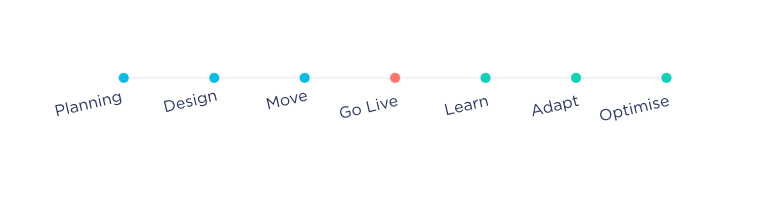
In our experience of supporting clients through complex, high-profile office moves, go-live is not the point at which uncertainty disappears. It is when uncertainty becomes visible.
Decisions today, occupation years later
Major moves across legal and professional services bring this challenge into focus, with some prominent firms planning new workplaces five years before occupation.
Simmons & Simmons announced in March 2025 that it would relocate its London office to 25 Finsbury Circus in 2030. The firm's plans include flexible office layouts, wellbeing facilities, amenities and significant sustainability ambitions.
In February 2026, Herbert Smith Freehills Kramer announced an agreement for a new London office at 8 Exchange Square, with occupation also expected in 2030. It described the future environment as being designed around the needs of its people and clients, with modern workspace, dedicated reception and ambitious sustainability objectives.
Both examples illustrate the length of the planning horizon, with workplace plans being shaped several years before occupation. Yet the expectations of how employees and clients will interact with that workplace will continue evolving throughout the intervening period.
Trying to predict every requirement is therefore unlikely to be enough. A better question might be: how can adaptability be designed into the way the workplace will operate?
Protecting the value of the investment
Knight Frank's 2025 research found that financial and professional services were driving London office demand, while legal and financial occupiers led overall capital expenditure per project because of their high design specifications and performance expectations. Two-thirds of new London leasing activity was focused on premium or comprehensively refurbished office space, compared with around 45% before the pandemic.
The cost of creating these environments is substantial. Published UK benchmarks place a typical office fit-out at between £58 to £120 per square foot, depending on specification and scope. For a major London office, that will represent a multi-million-pound commitment. Add the time, capital and management attention involved, and the cost of getting the operating experience wrong after move-in becomes significant.
When the plan meets human behaviour
Before occupation, workplace decisions inevitably rely on data, insights, research and assumptions. There will be detailed forecasts around occupancy, meeting rooms, visitor flows, technology, service demand and employee behaviour. Intricate processes will be designed. Systems will be configured. Teams will be trained.
Then people arrive. This is the moment when planned behaviour meets actual behaviour, and often this is where the friction appears.
Clients may use spaces differently than expected. Employees may continue using familiar processes rather than adopting new ones. New technology may not integrate with established workflows as expected. Demand may peak in different places. Seemingly small questions or unintended workarounds may begin appearing repeatedly, creating a disproportionate operational impact. None of this necessarily means that the workplace has been designed badly. It means that occupation reveals frictions and frustrations that planning alone cannot fully predict.
Before go-live, organisations design around forecasts, requirements and evidence-based assumptions. After go-live, they can improve using real operational data.
The opportunity is to make that second stage a deliberate part of the transformation. The experience at City law firm Travers Smith offers a practical example. Ahead of its move to Stonecutter Street, ComXo worked onsite to understand the firm's room-booking environment, processes and systems, building the operational knowledge needed before the new office went live. This helped protect continuity through the transition and created an opportunity to evolve and tailor familiar processes for the new workplace.
After go-live, flexible overflow and out-of-hours support gave the front-of-house team additional resilience as demand changed, while ongoing service observations highlighted further opportunities for improvement.
The learning extends beyond room booking: an office move is an opportunity to understand existing friction, remove unnecessary complexity and build resilience before it reaches the new workplace.
Friction isn't always failure
One complication is knowing which feedback signals require action, particularly during the pace and pressure of the go-live phase. A new workplace asks people to adjust in several ways. New surroundings, systems, services and working practices inevitably create a period of acclimatisation.
The challenge is knowing how and when to respond. Respond to every complaint immediately and there is a risk of reshaping the new environment around legacy behaviours that the move was intended to change. Ignore emerging problems for too long and genuine operational friction can become embedded, creating lasting service or experience issues.
Travers Smith managed this phase through a structured change-request process. Following the move, requests were documented and reviewed rather than triggering an immediate response. This helped the firm avoid reacting too quickly to requests that might reflect legacy behaviours, while giving people time to acclimatise to the new working environment.
The principle extends beyond any single process. Organisations need to distinguish between the temporary friction of change and evidence that something genuinely isn't working. That requires governance and operational insight, rather than gut feel alone.
The workplace is already telling you where the friction is
Everyday workplace interactions make operational friction visible. A request for help is a service interaction. So is a room-booking query, a repeated question, a failed handover or an escalation.
Individually, each may appear relatively insignificant. Collectively, they can begin telling an organisation something about how effectively its workplace is functioning.
- Are the same questions repeatedly being asked?
- Are employees bypassing self-service?
- Are particular processes difficult to navigate?
- Where does demand regularly exceed available capacity?
- Which issues disappear as people acclimatise, and which persist?
At Travers Smith, the activity handled following go-live provided more than service continuity. It also highlighted opportunities across knowledge, self-service, process, technology and reporting, creating a clearer picture of where actual workplace behaviour differed from the planned experience.
The significance goes beyond room booking. Interactions are not simply transactions to be processed. They can provide evidence of where the lived workplace experience differs from the one that was designed. That is potentially one of the most valuable sources of post-occupation intelligence available to workplace leaders.
Client and employee experience determines whether the workplace delivers
This becomes more important as organisations encourage people to spend more time together in the office. Research from JLL suggests that employees broadly recognise the value of being together in the office, but their response to more structured attendance is closely connected to the wider workplace experience. For organisations investing heavily in new offices, the challenge is therefore not simply to get people through the door, but to ensure the experience works once they arrive.
The new office may be beautifully designed, technically advanced and environmentally efficient. But employees and clients experience it through everyday journeys: finding the right space, accessing support, arranging meetings, welcoming visitors, resolving problems and navigating the organisation. That places the operating experience alongside the physical workplace as part of the overall return on the investment.
Build for uncertainty rather than trying to eliminate it
There is no realistic way for an organisation planning a move today to know precisely what will be required several years from now. Perhaps that shouldn't be the objective.
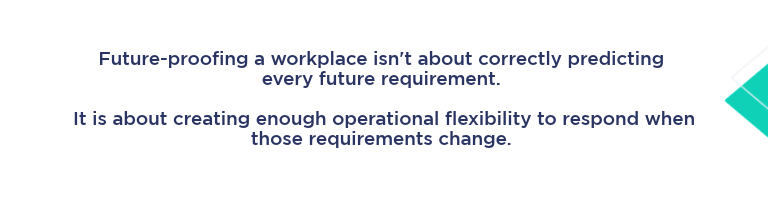
That means balancing resilience with efficiency, building knowledge before it is urgently needed, understanding where capacity can flex and creating clear routes for navigation and escalation. Critically, it also means establishing ways to listen to what workplace interactions reveal after occupation. An operating model capable of adapting and scaling alongside the organisation changes how the success of an office move should be measured.
The question at go-live is understandably: Did we deliver what we planned? Have we created an operating experience capable of adapting to what happens next?
The more valuable question over the months and years that follow may be: Have we created an operating experience capable of adapting to what happens next?
The move is a milestone. The workplace keeps moving. A new office represents years of planning and millions of pounds of investment. Yet opening the doors cannot be the end of the workplace transformation programme. It is the point at which many of the assumptions behind that investment finally encounter operational reality.
For COOs, Transformation and Client Experience Leads, the opportunity is therefore to widen the scope of office-move planning. Alongside property, design and technology, leaders need to consider how the workplace will operate, how service and experience will be protected as demand changes, and how the organisation will recognise when something isn't working as intended. This is where ComXo sees an important shift in workplace thinking.
The physical workplace provides the environment, but the operating model determines how effectively people navigate and experience it, while the interactions taking place every day provide the intelligence needed to keep improving it.
For organisations making long-term workplace decisions in a world that will continue to change, adaptability may ultimately prove more valuable than trying to get every assumption right on day one.